


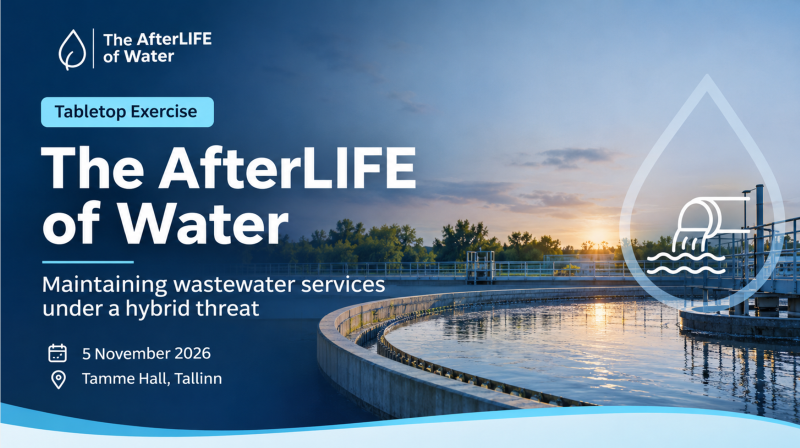
On 5 November 2026, CESERE, in collaboration with Taivo Kangilaski, Senior Researcher at TalTech, conducted a critical infrastructure tabletop exercise focused on wastewater service continuity and cross-sector resilience.
The exercise was part of the international seminar “The AfterLIFE of Water“, held at the Estonian Ministry of Climate.
Exploring cascading impacts and interdependencies
The scenario-based exercise examined how disruptions to critical infrastructure can affect essential services and the organisations, communities and residents that depend on them.
Participants approached the evolving crisis from different operational and societal perspectives, including wastewater operators, local government, electricity and telecommunications infrastructure, critical service users, technical support, and the needs of communities and residents.
The exercise emphasised response measures, coordination needs and preparedness for further escalation. Building on the participants’ existing experience in crisis management, discussions focused on cascading impacts, interdependencies and the different perspectives of stakeholders involved in maintaining essential services.
A central insight was that resilience is tested not only within individual organisations, but also in how effectively they coordinate when disruptions cascade across critical infrastructure and the services that depend on it.
Key takeaways
The discussions highlighted three important aspects of crisis preparedness and cross-sector resilience.
- Communication and shared situational awareness are essential. Proactive information exchange, a shared understanding of terminology and a common interpretation of the evolving situation are important prerequisites for effective coordination between stakeholders.
- The same crisis may have different implications for different stakeholders. Responsibilities, priorities, perceived impacts and operational disruptions may differ considerably, influencing how organisations assess the situation and choose their response measures.
- Resources alone do not ensure preparedness. Planning and acquiring emergency resources must be accompanied by regular practical training in their use and the ability to apply crisis response procedures in real situations.
Strengthening resilience through scenario-based exercises
Multi-actor tabletop exercises provide a structured setting to examine different roles, responsibilities, and interdependencies. They enable participants to explore assumptions, consider alternative response decisions and improve mutual understanding across organisational boundaries.
Such exercises are also a practical means of connecting risk analysis, preparedness planning and collaborative decision-making.
Through scenario-based exercises and crisis analysis, CESERE contributes to the development of integrated approaches to critical infrastructure resilience, crisis preparedness and cross-sector cooperation.